Relative density and its role in soil stability
Relative density of soil is crucial in geotechnical engineering to assess the stability and load-bearing capacity of soil for foundation design purposes. It directly influences the behaviour of granular, cohesionless soils (such as sand and gravel) under load. Relative density is needed to assess the soil strength and stability of foundations. High relative density means higher soil strength whereas low relative density is a sign of weaker, prone to settlement or potentially liquefiable soil.

During construction, when dealing with general or engineering fill, relative density is very important to control the compaction efforts. Controlling compaction ensures that the fill will achieve the desired strength and stability which directly affects the safety and performance of the foundations.
Main field and laboratory tests to control relative density are the following:
Relative density test (involves lab and filed procedures) is used to estimate compaction as a percentage with regards to the maximum and minimum void ratios/densities.
Standard or modified proctor test (lab) is used to benchmark the field compaction efforts to the maximum density achieved with the proctor
Sand cone test is used to determine the in-situ density of the compacted soil
California bearing ration (CBR) is often used in pavement design to assess the strength of the compacted soil and subgrade
Dynamic cone penetrometer measures the resistance of the soil by a cone driven into the ground. Resistance is correlated with the soil’s compaction and strength.
Plate load test although mainly used for bearing capacity and settlement calculations can be used to assess compaction quality.
All of these tests can verify that when granular soils are used as fill materials, as well as the construction methodology and compaction efforts, meet the project requirements and specifications.
Soil can be classified based on relative density to the following compaction categories that correspond to typical soil behaviors as follows:
Relative Density (%) | Description | Typical Behavior |
0 - 15% | Very loose | Highly compressible, low strength |
15 - 35% | Loose | Moderate compressibility, low strength |
35 - 65% | Medium dense | Moderate strength and compressibility |
65 - 85% | Dense | High strength, low compressibility |
85 - 100% | Very dense | Very high strength, minimal compressibility |
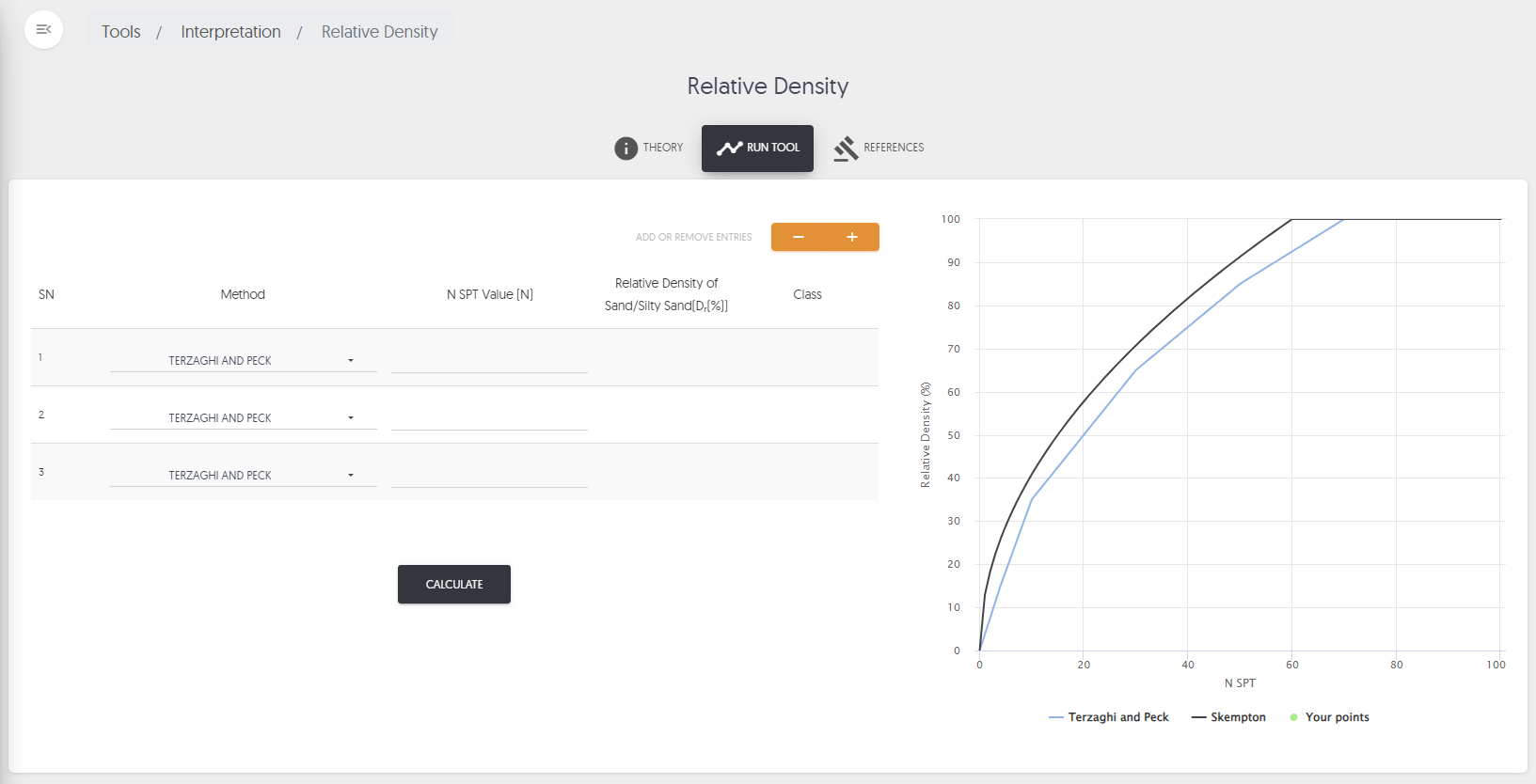
In instances where relative density results are not directly available from the aforementioned tests, it might be useful to estimate it from standard penetration N SPT blow counts. The main two general accepted correlations to estimate relative density from N SPT are those from Terzaghi and Peck, 1967 and Skepton, 1986.
In order to better understand how N SPT blow counts are correlated to relative density you can check our free to use, on-line relative density geotool.