As geotechnical engineers, we spend countless hours reading, reviewing, and analyzing factual and interpretative reports. But how often do we truly look into our data? Dive into geotechnical data files with Orycta XPLORE.
Beyond PDFs: Dive Beneath with Orycta XPLORE
As geotechnical engineers, we spend countless hours reading, reviewing, and analyzing factual and interpretative reports. But how often do we truly look into our data?
How do we ensure the quality of the information we receive? How do we preserve and access this data years down the line? How do we verify that the data files match the PDF reports we're reading and that any corrections or comments we make in the PDFs are also reflected in the actual datasets? More importantly, how do we compare new geodata with historical records? How do we learn from our data?
Let’s face it, as geotechnical engineers we love PDFs. We might even print out parts of the report when we really need to focus and understand the subsurface. But PDFs were never designed to store or manipulate data; they were meant to present or print information, and they do this nicely.
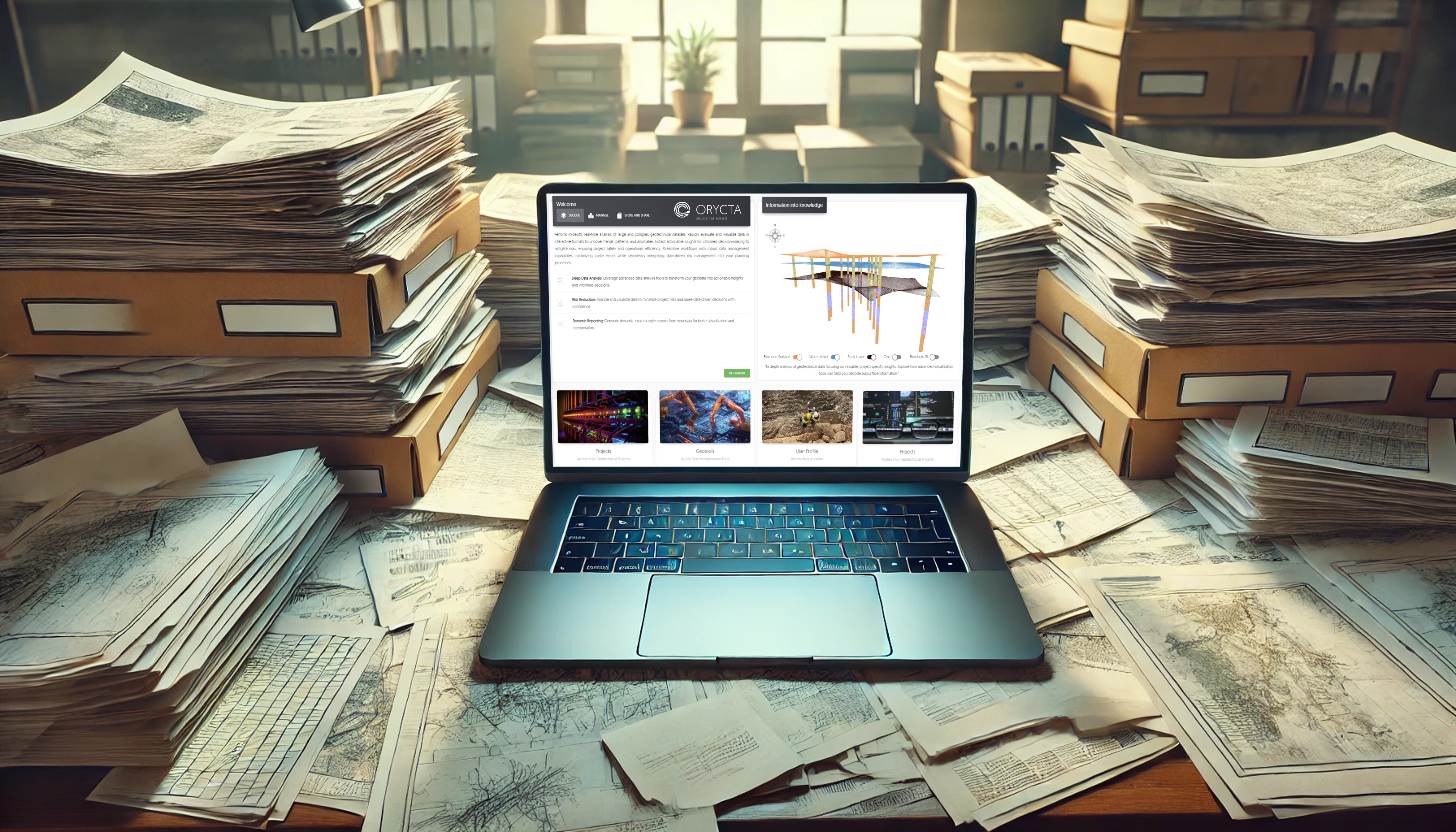
Geotechnical data files (like AGS or DIGGS) are created by humans, often typists or - if you are lucky - junior geotechnical engineers. And guess what? When handling large datasets, whether it is 20 or 500 boreholes, typos, errors, and omissions are inevitable.
So next time you are reviewing a PDF report, ask yourself:
Do you actually have access to the raw data?
Have the mistakes in the data files been corrected, or are you just updating the PDF while the original dataset rests untouched on a hard drive?
How many “small” errors today will become major headaches tomorrow, reducing the reliability and long-term value of your data?
This post is not about the importance of data in the years to come. We “walk the talk” at Orycta. We recognize the importance of geotechnical data, and we have built the best platform out there to do just that: read your geotechnical data files and generate on the fly full reports, 3D visualizations, sections, graphs, you name it.
So now you have no excuses, but to start reviewing your actual geotechnical data files.
If it doesn’t matter today, it will tomorrow.
Access Orycta XPLORE here.

As digitization and visualization of geotechnical data become more and more relevant in today’s fast-paced projects, geotechnical engineers and geologists are increasingly required to deal with vast amounts of data and produce easy-to-read visualization graphs and models.
The challenges of programming and automation in engineering and construction
The Casagrande Plasticity Chart is a graphical tool used in geotechnical engineering to classify fine-grained soils based on their plasticity characteristics.
Understanding relative density is essential when it comes to soil densification, particularly for cohesionless soils as it helps engineers make informed decisions about the need for densification and the methods required to achieve the desired soil stability for construction projects.
Why bother digitizing your geotechnical data? Ensuring competitiveness in geotechnical engineering in an increasingly data-driven era.
The execution of large-scale soil improvement works across the GCC has provided critical insights into the complexities of working with challenging geotechnical conditions in arid and coastal environments. One key lesson is the importance of tailoring improvement techniques, such as roller compaction, dynamic compaction, vibro-compaction, vibro-replacement and deep soil mixing, to site-specific soil profiles and conditions.
Anyone working in the United Arab Emirates (UAE) or GCC knows that our ground conditions are anything but straightforward. We often deal with medium-dense to dense sands transitioning into sandstone or calcarenite, with varying degree of cementation. It’s that grey zone between soil and very weak rock that makes interpretation and design so ch
Are you an engineer passionate for new technologies and programming? Have an exciting project and want to explore what automation and AI can do for you? Want to join our growing team or provide recommendations for future developments?
We want to hear from you!
info@orycta.com